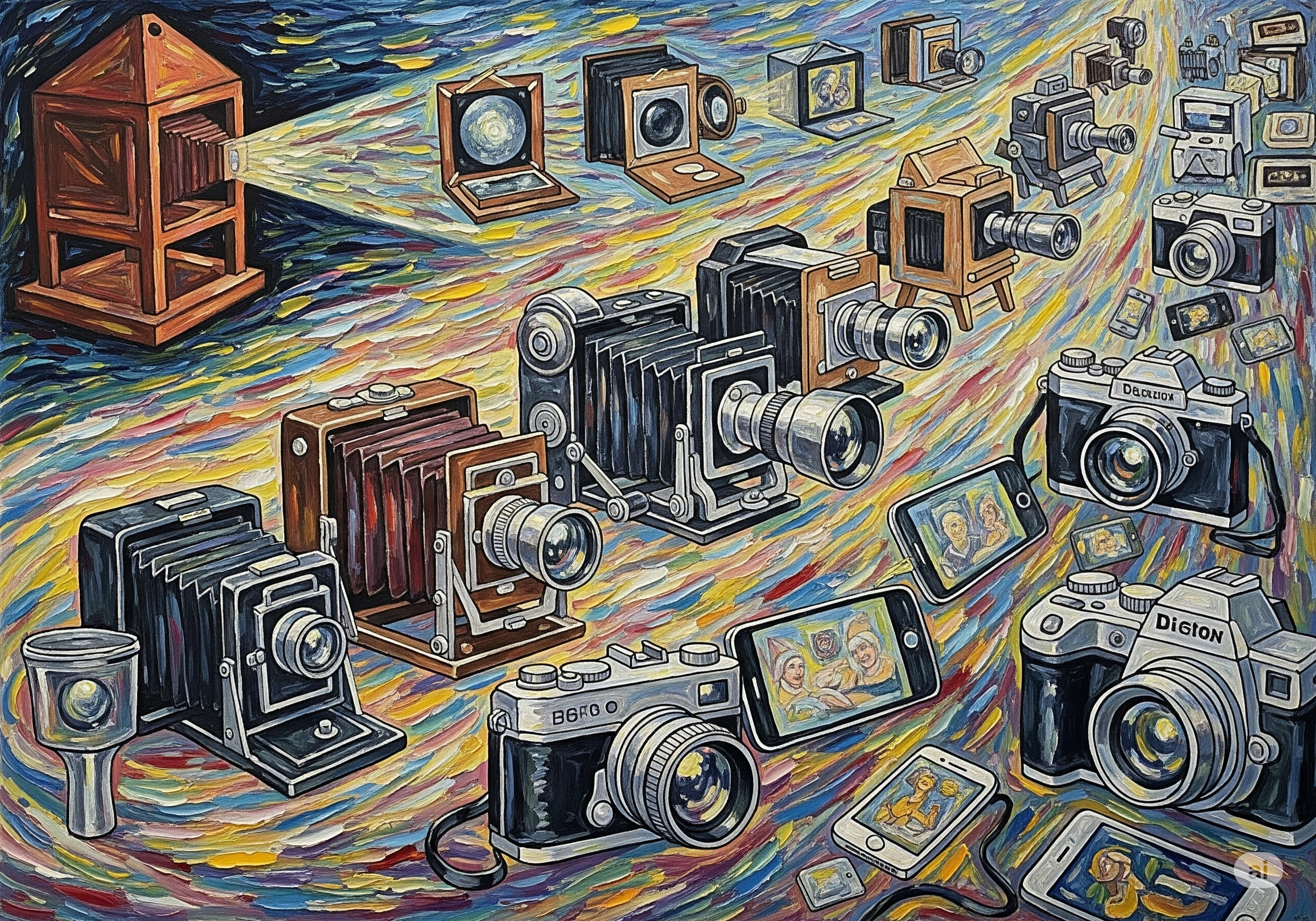
カメラの歴史は、光と影、そして人間の視覚を記録したいという根源的な欲求の歴史だと言えるだろう。その道のりは、初期の巨大な装置から、現代のポケットに入るスマートフォンに至るまで、驚くべき発展を遂げてきた。
カメラの発明と初期の発展
カメラの原型は、古代から知られていた「カメラ・オブスクラ(暗い部屋)」に遡る。これは、小さな穴から入った光が、暗い部屋の壁に外界の景色を逆さまに映し出す現象を利用したものだ。画家が風景を描く際の補助として使われた歴史がある。
写真が実用化されたのは、19世紀初頭、フランスのニエプスがアスファルトの薄膜を使って世界初の写真を発明したのが始まりだ。しかし、この写真は露光時間が非常に長く、実用には程遠かった。その後、ダゲールが改良を加え、1839年に「ダゲレオタイプ(銀板写真)」を発表。これが商業的に成功した最初の写真術となった。この頃のカメラは、まだ大型で、手動での操作が多く、専門的な知識と技術が必要だった。
フィルムカメラの多様化と普及
20世紀に入ると、写真フィルムの登場と技術革新により、カメラは飛躍的に多様化し、一般の人々にも手が届く存在になっていく。
- ボックスカメラやフォールディングカメラ:より小型化され、簡易な操作で写真が撮れるようになり、レジャーなどでも使われ始めた。
- レンジファインダーカメラ:ファインダーで二つの像を重ね合わせることでピントを合わせる方式で、レンズ交換が可能で、コンパクトながら高性能なモデルも登場した。
- 一眼レフカメラ(SLR):レンズを通した光をミラーで反射させ、光学ファインダーで直接像を確認できる画期的な仕組みが導入された。これにより、ファインダーで見える像と実際にフィルムに記録される像が一致するようになり、精密なフレーミングとピント合わせが可能になった。プロやハイアマチュアに広く普及し、交換レンズシステムが発展していく礎を築いた。
- 二眼レフカメラ(TLR):撮影用とファインダー用の二つのレンズを持つタイプで、特徴的な外観と独特の操作感があった。
- コンパクトカメラ(レンズ付きフィルム):さらに手軽に写真が撮れるようにと、レンズが固定され、操作を簡略化したモデルが登場。特に「レンズ付きフィルム(使い捨てカメラ)」は、手軽さから爆発的に普及し、写真が日常の一部となるきっかけを作った。
- インスタントカメラ:ポラロイド社が開発した、撮影後すぐに写真が現像されるカメラは、その場で思い出を共有できるという点で画期的だった。
デジタルカメラとミラーレスカメラの時代
20世紀の終わりから21世紀にかけて、カメラは再び大きな転換期を迎える。それがデジタル化だ。
- デジタルカメラ(コンデジ):フィルムの代わりにCCDやCMOSといったデジタルセンサーが光を電気信号に変換し、画像データとして記録するカメラが登場した。フィルムの現像が不要になり、撮影画像をその場で確認できる、大量に撮影してもコストがかからないなど、多くのメリットが消費者に受け入れられ、瞬く間に普及した。
- デジタル一眼レフカメラ(DSLR):既存の一眼レフカメラの仕組みにデジタルセンサーを搭載したもので、プロやハイアマチュアの間で急速に普及。フィルム時代からのレンズ資産を活用できる点も強みだった。
- ミラーレス一眼カメラ:そして近年、カメラの仕組みを根本から見直したのがミラーレス一眼だ。一眼レフにあったミラーボックスをなくすことで、カメラボディの大幅な小型・軽量化を実現。レンズから入った光を直接センサーで受け止め、その映像を電子ビューファインダー(EVF)や背面液晶モニターに表示する。これにより、リアルタイムでの露出確認や高精度なオートフォーカス、そして高速な連写が可能になり、今やプロの現場でも主流となっている。
- スマートフォン(カメラ機能付き携帯電話):カメラ専用機ではないものの、高性能な小型カメラを搭載したスマートフォンは、常に持ち歩ける手軽さから、世界で最も使われているカメラとなった。AIによる画像処理や多様なフィルター機能も充実し、写真の楽しみ方を大きく変えた。
まとめ
カメラの歴史は、アナログからデジタルへ、そして「記録」から「共有」へと、その役割を変化させながら進化を遂げてきた。各時代の技術革新が、より手軽に、より高画質に、そしてより多様な表現を可能にしてきたのだ。これからもカメラは、私たちの視覚体験を豊かにし続けることだろう。
The history of cameras can be described as the history of light and shadow, and the fundamental human desire to record visual experiences. Its journey has seen remarkable development, from the massive devices of early days to the smartphones that fit into our pockets today.
The Invention and Early Development of Cameras
The origin of cameras can be traced back to the “camera obscura (dark room),” known since ancient times. This utilized the phenomenon where light entering through a small hole projected an inverted image of the outside world onto the wall of a dark room. It was historically used by painters as an aid for drawing landscapes.
The practical application of photography began in the early 19th century when Nicéphore Niépce of France invented the world’s first photograph using a thin film of asphalt. However, this photo required an extremely long exposure time, making it far from practical. Later, Louis Daguerre made improvements and announced the “Daguerreotype” in 1839. This became the first commercially successful photographic process. Cameras of this era were still large, largely manual, and required specialized knowledge and skill.
Diversification and Popularization of Film Cameras
Entering the 20th century, with the advent of photographic film and technological innovations, cameras dramatically diversified and became more accessible to the general public.
- Box cameras and Folding cameras: These became more compact and allowed for easy photography, starting to be used for leisure activities.
- Rangefinder cameras: This type focused by superimposing two images in the viewfinder. Interchangeable lenses became possible, and compact yet high-performance models emerged.
- Single-Lens Reflex (SLR) cameras: A revolutionary mechanism was introduced where light passing through the lens was reflected by a mirror, allowing the photographer to directly view the image through an optical viewfinder. This ensured that the image seen in the viewfinder matched what was actually recorded on film, enabling precise framing and focusing. SLRs became widely popular among professionals and serious amateurs, laying the foundation for the development of interchangeable lens systems.
- Twin-Lens Reflex (TLR) cameras: This type had two lenses, one for taking the picture and one for the viewfinder, featuring a distinctive appearance and unique operational feel.
- Compact cameras (Disposable cameras): To make photography even more accessible, models with fixed lenses and simplified operations appeared. In particular, “disposable cameras” (film with lens) gained explosive popularity due to their ease of use, making photography a part of everyday life.
- Instant cameras: Developed by Polaroid, these cameras developed photos immediately after shooting, which was groundbreaking in terms of instantly sharing memories.
The Era of Digital Cameras and Mirrorless Cameras
From the end of the 20th century to the 21st century, cameras underwent another major transformation: digitization.
- Digital cameras (Compact digital cameras): Cameras emerged that used digital sensors like CCDs or CMOS to convert light into electrical signals and record them as image data, replacing film. Many benefits, such as not needing film development, being able to review captured images instantly, and not incurring costs for taking many photos, were embraced by consumers, and they rapidly gained popularity.
- Digital Single-Lens Reflex (DSLR) cameras: These incorporated digital sensors into the existing SLR camera mechanism and quickly became popular among professionals and serious amateurs. The ability to utilize existing lens assets from the film era was also a strong point.
- Mirrorless interchangeable-lens cameras: In recent years, mirrorless interchangeable-lens cameras have become mainstream, fundamentally rethinking the camera mechanism. By eliminating the mirror box found in DSLRs, they achieved significant reductions in camera body size and weight. Light entering from the lens is received directly by the sensor, and that image is displayed on an electronic viewfinder (EVF) or the rear LCD monitor. This enabled real-time exposure confirmation, highly accurate autofocus, and high-speed continuous shooting, and they are now dominant even in professional settings.
- Smartphones (Camera-equipped mobile phones): Although not dedicated cameras, smartphones equipped with high-performance compact cameras have become the most used cameras worldwide due to their portability. Advanced AI-powered image processing and various filter functions have also enriched the ways people enjoy photography.
Conclusion
The history of cameras has been one of evolution, transforming its role from analog to digital, and from “recording” to “sharing.” Technological innovations in each era have made photography easier, higher in quality, and allowed for more diverse expressions. Cameras will continue to enrich our visual experiences in the future.

コメント